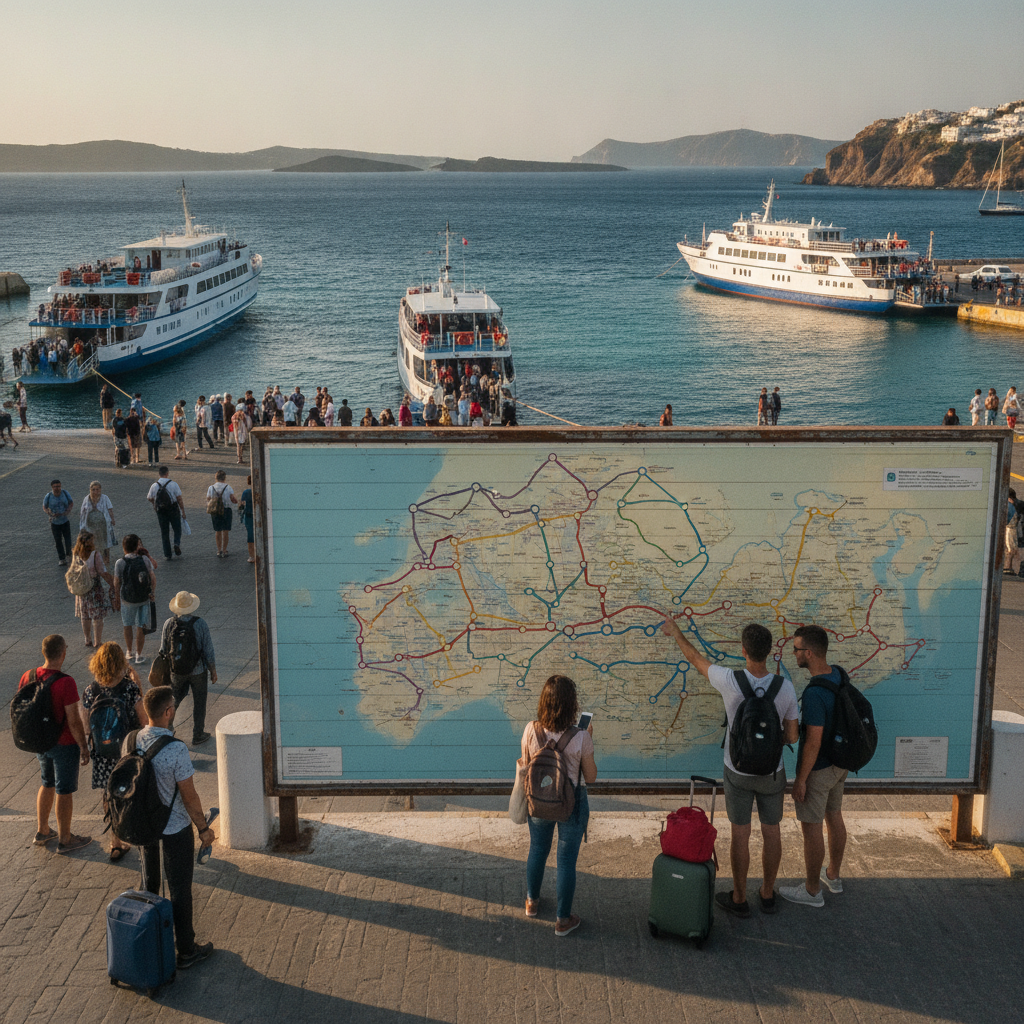
The Greek islands reward travelers who resist the urge to over-plan. Anyone who has booked a rigid group tour through the Cyclades only to find themselves rushing past a sunset in Santorini or skipping a spontaneous afternoon in a quiet harbor village knows exactly what's lost when flexibility disappears. The good news is that Greece's extensive ferry network makes it entirely possible to build a self-directed itinerary that adapts to weather, mood, and budget — without paying a tour operator to decide when you leave.
Understand How the Ferry System Actually Works
Greece operates one of the densest ferry networks in the Mediterranean, with major carriers like Hellenic Seaways, Blue Star Ferries, and SeaJets connecting dozens of islands across multiple routes. The system isn't a single circular loop — it's a web of overlapping lines radiating outward from Piraeus, the port of Athens. Certain hubs, like Mykonos, Paros, and Naxos, appear on multiple route lines, which makes them ideal pivot points when you want to change direction mid-trip. Understanding this structure before you book anything is the first step toward building a genuinely flexible plan.
Use Ferryhopper to Map Connections Before Committing
Ferryhopper is one of the most useful planning tools available for independent travelers in Greece. The platform visualizes route connections across all major carriers and lets you compare journey times, ferry classes, and pricing without locking in a purchase. Before booking a single ticket, spend time exploring what connections exist between your target islands. You'll quickly spot which destinations are well-served daily and which have only two or three departures per week. That frequency information matters enormously when you're building a flexible itinerary, because a low-frequency route is a flexibility trap.
Anchor Your Itinerary Around Two or Three Hub Islands
Rather than booking a fixed sequence of islands, structure your trip around two or three well-connected hubs and leave the smaller stops open. Paros, for example, connects to Naxos, Ios, Santorini, Mykonos, and several less-visited islands like Koufonisia and Amorgos. Staying two or three nights in Paros gives you time to explore it properly while keeping your onward options genuinely open. From there, the decision about where to go next can be made the day before departure based on weather reports, how long the lines look at the port, or simply what you feel like doing. This is the structural core of flexible island-hopping.
Buy Tickets Two to Three Days Out, Not Months Ahead
One of the most common mistakes travelers make is booking every ferry leg months in advance, treating the Greek ferry system like a budget airline that penalizes late purchases. For most routes, outside of peak August weekends, buying tickets two to three days before departure gives you enough availability without sacrificing flexibility. Services like Greek Travel Pages aggregate real-time schedules and availability. Booking too far ahead locks you into a chain of departure times that can't accommodate a last-minute extension in a place you love or a detour to an island you hadn't considered. Keep the chain loose.
Match Ferry Class to Journey Length
Greek ferries vary considerably in comfort and speed, and choosing the wrong class for a long crossing can make a scenic journey genuinely uncomfortable. For short hops of one to two hours between nearby islands, a standard deck ticket on a conventional ferry is perfectly reasonable and often the cheapest option. For crossings of four hours or more — say, from Piraeus to Santorini — a cabin or airline-style seat on a high-speed craft from a carrier like SeaJets is worth the premium. Arriving rested means your first afternoon on a new island is actually enjoyable rather than spent recovering from a rough open-deck crossing.
Factor Port Towns Into Your Island Assessment
Not every Greek island port is equally convenient, and the port town experience matters more than travelers often expect. Naxos Town sits directly at the port with an Old Town worth exploring immediately. Santorini's main port, Athinios, requires a bus or taxi ride up to Fira, adding time and cost to every arrival and departure. Knowing this in advance helps you allocate realistic time buffers and avoid the frustration of missed connections. Research each port's logistics during the planning phase so your flexible itinerary accounts for transfer time, not just ferry schedules.
Watch for Seasonal Route Variations
The Greek ferry network doesn't operate at the same frequency year-round. Some connections that run daily in July and August drop to three or four times per week in late September and October, and certain smaller island routes suspend entirely outside summer. For travelers heading to the islands in shoulder season — which remains one of the smartest ways to reduce overall trip costs — it's worth checking current schedules rather than relying on route maps from previous years. Schedules are updated seasonally, and a route that looks like a flexible option on a general map may have limited operational windows in practice.
Keep One Night Unbooked in Each Destination
The final piece of a truly flexible Greek island itinerary is accommodation strategy. Booking every night in advance defeats the purpose of leaving ferry connections open. A practical middle ground is to book the first night in each destination before arrival — which guarantees you have somewhere to sleep after a long crossing — while leaving subsequent nights open until you know how long you actually want to stay. Platforms like Booking.com show real-time availability on shorter notice in most island towns outside of peak August, making last-minute extensions genuinely manageable rather than stressful.
The Greek ferry system will likely expand its high-speed connections in coming years, with routes to less-visited islands in the Dodecanese and Ionian groups becoming more frequent and accessible. Travelers who learn to read the network now are building a skill that only becomes more valuable as independent island-hopping grows more popular and tour alternatives become easier to assemble on your own terms. The islands have always rewarded curiosity — the ferry network just gives you the infrastructure to follow it.