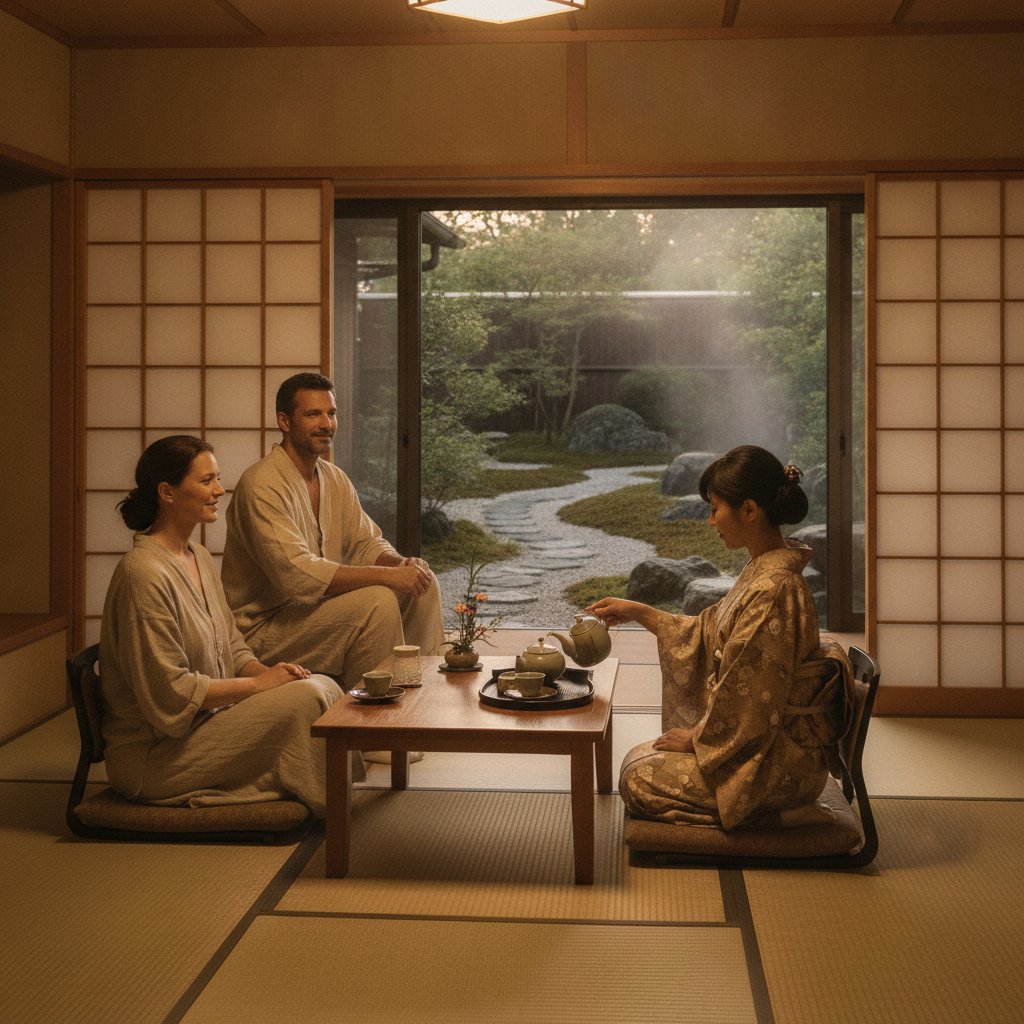
There is a particular moment that many Western travelers describe after their first night in a traditional Japanese ryokan — a pause somewhere between waking and rising, when the silence feels deliberate rather than empty, when the smell of cedar and tatami settles into consciousness before a single demand has been made of the day. It is a moment that resists easy categorization. The room is spare. There is no minibar, no remote control with forty-seven channels, no pillow menu. And yet something about the experience registers as profoundly generous — more attentive, somehow, than the most elaborate hotel suite most travelers have encountered. That contradiction is worth sitting with, because it reveals something important about what comfort actually is, and how differently two cultures have chosen to construct it.
The Architecture of Restraint and Presence
The ryokan, as an institution, traces its roots back centuries in Japan, with establishments like Nishiyama Onsen Keiunkan in Yamanashi Prefecture operating continuously since the early eighth century — making it one of the oldest hotels in the world by any definition. But what distinguishes the ryokan from a historic hotel is not age; it is philosophy. The physical structure of a traditional ryokan is organized around the concept of *ma* — a Japanese spatial and temporal idea that translates roughly as meaningful negative space, the pause that gives shape to what surrounds it. Rooms are not filled to demonstrate value. They are arranged to allow presence. The low table, the folded futon, the single seasonal flower arrangement in the *tokonoma* alcove — each element is placed with the understanding that what is absent is as intentional as what remains. For a traveler accustomed to equating abundance with quality, this takes genuine adjustment.
Service inside a ryokan is delivered through a role that has no true Western equivalent: the *okami*, the proprietress or head attendant who oversees the guest's entire experience with a attentiveness that feels personal without being intrusive. She — though the role is not exclusively female — anticipates rather than responds. Meals appear in the room at the agreed hour, the futon is laid while guests bathe in the communal *onsen* or private mineral spring bath, and the rhythm of the stay is gently structured so that decisions feel unnecessary. This is not the invisible efficiency of a luxury hotel where staff are trained to be inconspicuous. It is something philosophically distinct: service as an expression of care rather than transaction, shaped by the concept of *omotenashi*, a form of hospitality that offers without expecting acknowledgment or gratuity in return.
What Kaiseki Reveals About Attention to Detail
The evening meal at a ryokan — typically a multi-course *kaiseki* dinner served in the guest's room or a private dining space — functions as a kind of argument for a different relationship between the traveler and place. Kaiseki is the formal culinary tradition of Japan, rooted in the tea ceremony and structured around seasonal ingredients sourced as locally as possible. At ryokan like Tawaraya in Kyoto or Gora Kadan in Hakone, the menu shifts not just seasonally but sometimes weekly, reflecting what the region's farmers, fishermen, and foragers have available at that precise moment. Each small dish arrives as its own considered statement — a slice of sashimi arranged to evoke a mountain stream, a broth that has simmered for hours to produce something that tastes of almost nothing and everything simultaneously. Western travelers accustomed to portion size as a measure of generosity often find themselves rethinking that equation by the final course. The meal is not small; it is precise. The distinction matters.
This precision extends to the bathing ritual, which in a ryokan context is not a hygiene task but a restorative practice. The *onsen*, fed by natural geothermal springs, is temperature-controlled and often gender-separated, with guests expected to wash thoroughly before entering the communal bath. The ritual asks something of the traveler: participation, not passive reception. This is another point where the ryokan experience diverges from Western luxury hospitality, which tends to deliver comfort rather than invite it. The ryokan asks guests to slow down, to follow a rhythm not of their own design, and to discover that relinquishing control over the schedule is itself a form of rest.
Rethinking What You're Actually Paying For
For travelers who encounter ryokan pricing for the first time, the figures can feel startling — a night at a respected establishment often includes dinner and breakfast, which adjusts the per-night comparison considerably, but the rates still exceed what many budget-conscious travelers expect. What shifts with experience is the understanding of what the cost represents. In a Western hotel, the rate generally covers access to a room and its amenities. In a ryokan, it covers time — structured, curated, unhurried time — along with the labor of people who have trained for years in textile arrangement, seasonal cooking, and the art of anticipating a stranger's comfort without asking what they need.
When you step into a ryokan for the first time, something in the pace of the place will ask you to put down more than your luggage. The *okami*'s greeting, performed with a slight bow and a quiet formality that feels neither cold nor performative, establishes immediately that the relationship is different here. No one will upsell you at check-in. No one will ask if you want to upgrade. The experience has already been considered on your behalf, and the only thing asked in return is that you receive it — fully, without rushing toward the next item on a list. For travelers who have spent years measuring quality by the thickness of a robe or the size of a television, that shift in frame can feel disorienting at first, and then, quite unexpectedly, like relief.
The ryokan doesn't argue against Western hospitality so much as it quietly demonstrates that comfort is a design choice, and that the assumptions built into that choice are not universal. The silence that greeted the traveler on that first slow morning wasn't absence. It was the whole point — and once understood, it tends to follow a person home.