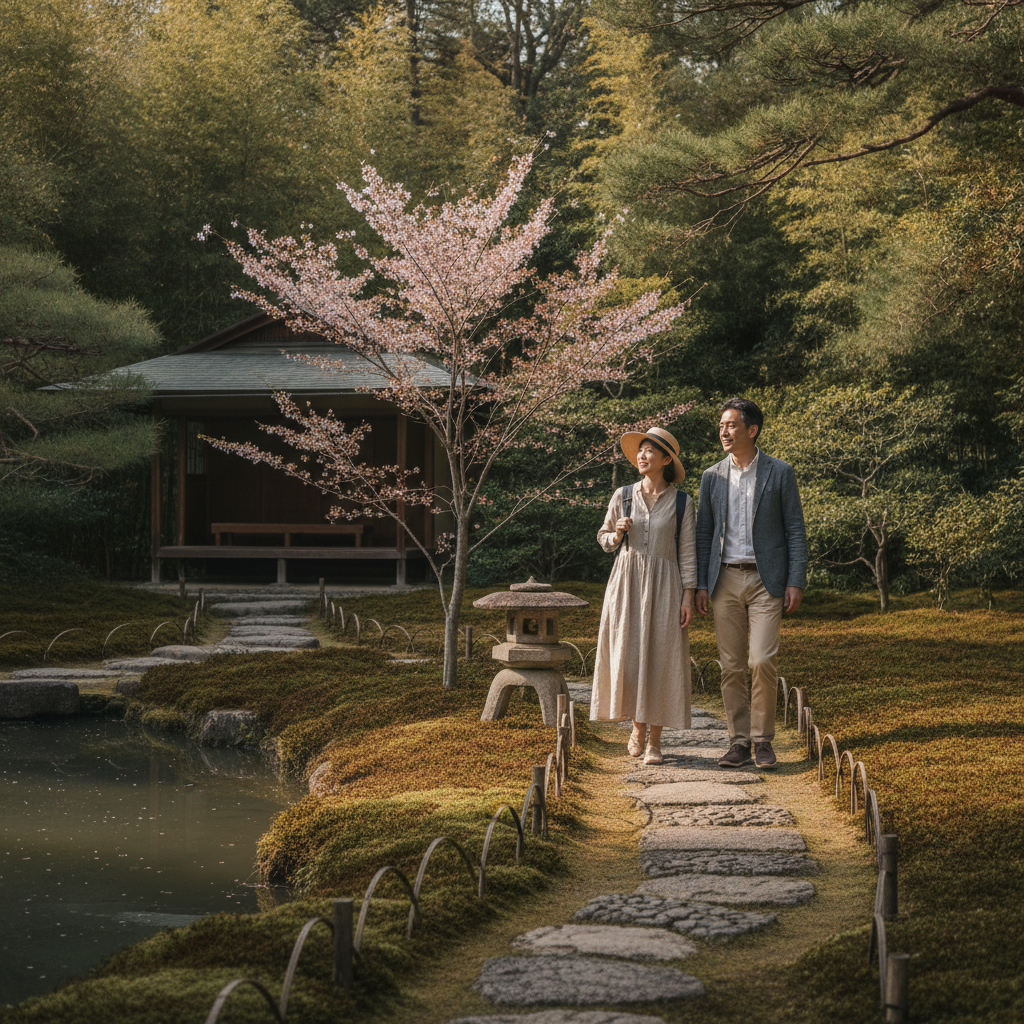
There is a particular kind of exhaustion that arrives not from work, but from the vacation meant to cure it. A traveler returns home from two weeks abroad having visited four countries, eight cities, and more museum lobbies than they can clearly recall, and feels — somehow — less rested than when they left. The suitcase is full of receipts and souvenirs. The body is jet-lagged. The mind is overstimulated. Something, clearly, went wrong. What went wrong, in many cases, is pace — specifically, the culturally inherited assumption that more coverage equals more value, and that a good trip is measured by the density of its itinerary rather than the quality of its presence.
Japanese travelers, as a general cultural pattern, approach this equation quite differently. The contrast is visible in how trips are planned, how days are structured, and most revealingly, in what is considered a successful return.
The Philosophy Behind Ma and Yutori
Two concepts from Japanese cultural life quietly shape the way many Japanese travelers think about movement and time. The first is *ma* (間), a term that describes the meaningful pause between things — the silence between musical notes, the empty space in a room, the breath between sentences. Ma is not vacancy; it is considered an active, necessary element of composition. The second is *yutori* (ゆとり), which translates loosely as spaciousness or breathing room, and refers to a quality of life with enough margin built in to allow for genuine reflection. Neither concept is applied consciously as a travel planning doctrine, but both appear to shape how itineraries get built — with deliberate gaps, slower transitions, and a preference for depth over breadth. A traveler shaped by these values might spend three nights in Kyoto not to check Fushimi Inari, Gion, and Arashiyama off a list, but to return to the same tofu restaurant twice and learn the name of the owner.
Fewer Destinations, Longer Presence
The structural expression of this philosophy shows up most clearly in destination count. Where a Western itinerary might hop between Tokyo, Osaka, Hiroshima, Kyoto, and Nara across ten days — treating each city as a station on a checklist — many Japanese leisure travelers build trips around one or two anchoring places and move more slowly through them. This is not about lacking curiosity or ambition; it reflects a different answer to the question of what travel is for. If travel is primarily for accumulation — of photographs, experiences, location tags — then maximum coverage makes sense. If travel is for restoration and genuine encounter, then lingering becomes the more sophisticated strategy. The neighborhood of Yanaka in Tokyo, the backstreets of Kanazawa, the rural inn culture of the Noto Peninsula — these are places that reveal themselves across days, not hours.
The Role of the Ryokan as Structural Reset
The *ryokan* (旅館), Japan's traditional inn, functions as more than accommodation. It is a designed environment for slowing down, and its rhythms exert a gentle gravitational pull on the traveler's day. Meals are served at set times and taken in the room or a common dining space; the *onsen* (温泉), or hot spring bath, operates on a communal schedule; the *futon* is laid out by staff at a specific hour. These rhythms remove decision fatigue from the evening entirely. There is nothing to scroll through, no restaurant to research, no Uber to call. The traveler simply arrives into the structure the ryokan provides, and the body begins, almost involuntarily, to decompress. Properties like Hoshi Ryokan in Ishikawa Prefecture or the network of small inns along the Nakasendo trail between Magome and Tsumago have been operating on this model for generations, and travelers who spend even two nights within one report a quality of rest that a five-star hotel with every amenity rarely delivers.
Purposeful Idleness as Cultural Value
There is also the matter of what Japanese travelers permit themselves to do with unstructured time. Sitting in a temple garden without photographing it. Watching rain fall on a stone path. Drinking tea without checking a phone. These behaviors are not laziness in the cultural framing — they carry a closer relationship to the concept of *mono no aware* (物の哀れ), the bittersweet awareness of impermanence that is central to Japanese aesthetic sensibility. To sit quietly in Ryoan-ji's rock garden in Kyoto and simply look is to participate in a centuries-old practice of contemplative attention. The tourist who photographs it and moves to the next site has visited. The traveler who sits for twenty minutes has arrived somewhere else entirely. This distinction — between visiting and arriving — is the quietly radical idea at the center of the Japanese approach to pacing.
What This Means for How You Plan
None of this requires booking a flight to Japan or adopting a philosophy wholesale. The principles translate to any destination and any budget. It means building deliberate margin into an itinerary — not as wasted time, but as the space where the trip actually becomes memorable. It means choosing one neighborhood in Lisbon over four, one coastal town in Croatia over an island-hopping sprint. It means accepting that the afternoon without a plan is not a failure of ambition but an investment in depth. Apps like Google Maps and TripAdvisor make it easy to fill every hour; the harder skill is resisting that filling. Travelers who return from a week in one place and say they could have stayed another week have learned something about a destination that the exhausted eight-city traveler rarely does.
The traveler who began this story — dragging an overfull suitcase through arrivals, more tired than when they left — was not underprepared. They were overpacked in the itinerary, not the luggage. Slowing down, as the Japanese cultural approach suggests, is not a compromise. It is, in fact, the more demanding and more rewarding form of travel — the one that asks you to be present long enough for a place to show you something it doesn't reveal in an hour.