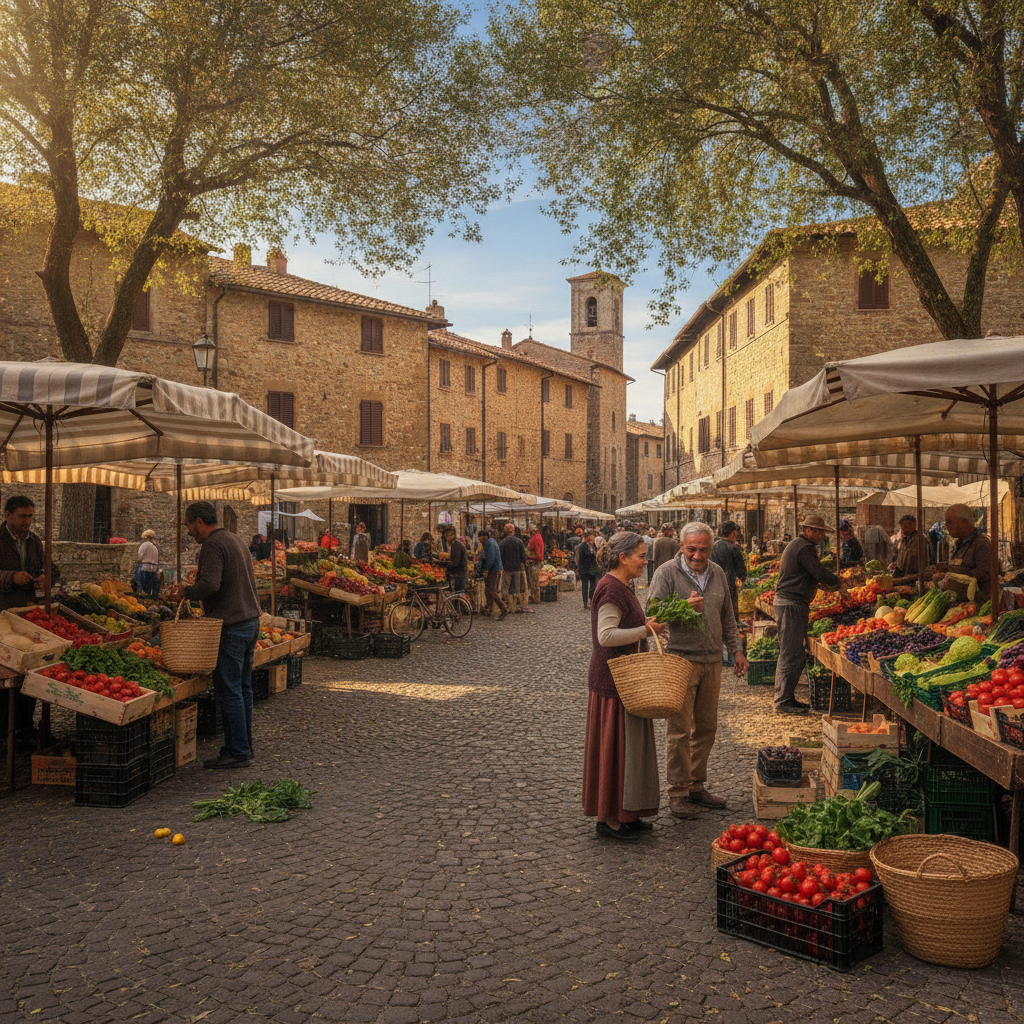
There is a particular kind of stillness that settles over a small European town in the hour before its weekly market opens. Wooden stalls appear where cobblestones usually lie empty. Farmers arrive in battered vans, stacking crates of produce with the unhurried confidence of people who have done this every Thursday, or every Saturday, for decades. The smell of bread, raw earth, and something floral arrives before the crowds do. No guidebook itinerary captures this — not because travel writers haven't tried, but because the market exists for the people who live there, not for the people passing through. That distinction matters more than most travelers realize when they're planning where to spend their time.
What the Market Reveals That Tourism Infrastructure Cannot
The weekly open-air market — known as a *marché* in France, a *mercato* in Italy, a *mercado* in Spain — is one of the oldest civic institutions in European rural life. It predates tourism by centuries, and that longevity shows in how it functions. Prices are set by what locals will pay, not by what visitors can be persuaded to spend. Conversations happen in dialect, not in the simplified, foreigner-friendly register common at popular attractions. A vendor haggling gently over the price of a wheel of aged cheese, or a retired farmer debating the quality of this season's olive oil with someone he's known for forty years, offers a kind of cultural transparency that no museum exhibit or curated food tour can replicate. The market is, in the most literal sense, a working document of how a community sustains itself.
There's also an economic honesty to it that rewards attentive travelers. In villages across Provence, the Dordogne, Umbria, and the hill towns of Extremadura, the weekly market anchors the local economy in ways that superstores and delivery services have only partially displaced. Regulars know which stall sells the best walnuts and which cheesemaker drives three hours to be there. Outsiders who show up with genuine curiosity — and the patience to slow down — are often welcomed into these small rituals rather than tolerated beside them. The key is arriving without an agenda, which is the one thing most structured itineraries make nearly impossible.
The Practical Case for Building Your Trip Around Market Days
Beyond the cultural depth, there is a straightforward practical argument for orienting travel around rural market schedules. Accommodation in smaller towns is almost always significantly cheaper than in regional capitals or major tourist corridors. A traveler staying in a village near Périgord, Siena, or the Ribera del Duero wine region will typically spend less on lodging, eat better food at lower prices, and encounter fewer of the friction points — crowds, inflated menus, scripted experiences — that drain both energy and budget in high-traffic destinations. Apps like Komoot and Rome2rio help with logistics, making it easier to plan movement between smaller towns that don't appear prominently on conventional tourist maps.
Market days also structure a visit in a way that feels organic rather than scheduled. Most rural European markets run weekly, often on the same day they have for generations, and planning arrival around them gives a trip a natural anchor without the rigidity of timed entry tickets and tour departure windows. A Wednesday morning in Apt, in the Luberon Valley, reveals something entirely different from a Saturday afternoon in the same town. The light is different, the vendors are different, and the pace of the place settles into something closer to its everyday self. That rhythm is what most travelers say they were looking for when they booked the trip in the first place.
Learning to Read a Place Through Its Produce
Markets are also, quietly, one of the most reliable ways to understand where you are geographically and seasonally. The produce on display isn't curated for photogenic variety — it reflects what the land is currently producing, what's eaten locally, and which crops define the agricultural identity of a region. White asparagus in the Rhine Valley in late spring, *borlotti* beans in Veneto in early autumn, dried peppers strung across a stall in rural Andalusia — these details tell a more grounded story about a place than any regional overview in a travel guide. They also provide a natural entry point for conversation, even across language barriers, because food is a subject on which most people have genuine opinions and visible pride.
Travelers who take the time to buy something — a jar of honey, a small wedge of local cheese, a bundle of herbs they'll carry back to their rental kitchen — participate in the market rather than simply observing it. That participation, however modest, shifts the dynamic in a meaningful way. Vendors remember faces. Return visits, even within the same week, are met with warmth that can feel disproportionate until you understand that regular customers are the entire point of a market like this. Being a temporary regular, even for a few days, is its own form of cultural access.
Bringing This Approach to Your Own Travel Planning
If you're planning a trip through rural France, Italy, Spain, or Portugal, consider building your itinerary outward from market schedules rather than from the standard list of attractions. Most regional tourism offices publish weekly market calendars, and a quick search for *marchés de Provence* or *mercati settimanali Toscana* will surface reliable listings. Give yourself at least two nights in any town where you plan to attend a market — one to arrive and orient, one to wake up knowing where everything is. Eat breakfast from a bakery stall. Buy lunch ingredients rather than sitting down at a restaurant. Walk slowly, carry a reusable bag, and resist the impulse to photograph everything before you've actually looked at it.
The traveler who spends a morning at a market in a village that doesn't appear in the top ten lists comes home with something harder to package but more lasting than a highlight reel of famous sights. They come home with a sense of how people actually live — what they eat, what they argue about, what they take pride in, and what they ignore entirely. That kind of knowledge doesn't fit neatly into a caption, but it's the closest thing to genuine understanding that travel can offer. It's the same stillness that hangs over those cobblestones before the stalls open: quiet, specific, and entirely real.