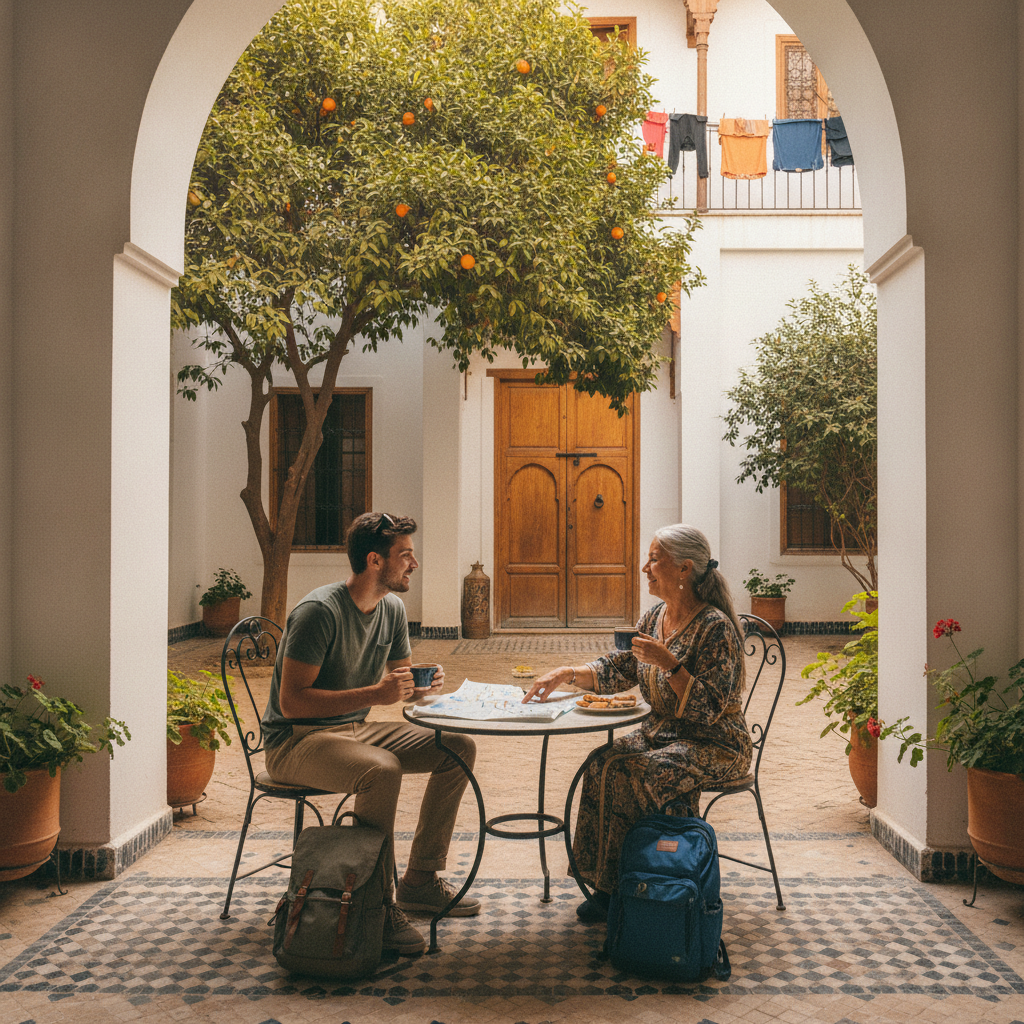
The first day in an unfamiliar city carries a particular kind of sensory overload — too many options, no instincts yet formed, and an acute awareness that every choice might be the wrong one. Most travelers default to the obvious solution: book a central hotel, stay near the landmarks, minimize uncertainty. It's a reasonable instinct, and it produces a reasonable trip. But there's something quietly lost in that arrangement, something that only becomes visible once a traveler has tried the alternative and felt the difference settle in around them.
The Geography of First Impressions
Where a traveler sleeps determines what they see first each morning, and that early-hour geography shapes everything that follows. A hotel in the tourist center places the visitor inside a kind of curated buffer zone — polished lobbies, menus in multiple languages, staff trained to translate the city into digestible, low-friction terms. It's efficient, and it's also a gentle form of insulation. The neighborhood guesthouse, by contrast, deposits the traveler directly into the texture of ordinary life. The street outside might smell of bread from a bakery that opens at six. The sound of a local market setting up might filter through the window by seven. These aren't amenities. They're invitations — and they arrive before the day has formally begun.
In Lisbon, for instance, staying in Mouraria rather than along the Avenida da Liberdade means waking up inside a neighborhood where fado — Portugal's deeply felt musical tradition of longing and fate — isn't a performance scheduled for tourists at nine in the evening. It's part of how the street sounds on a slow afternoon. That difference isn't small. It recalibrates the entire emotional register of the visit.
What Local Hosts Actually Offer
The concierge at a large chain hotel is knowledgeable and professional, but his recommendations are drawn from a reliable shortlist tested against thousands of guests with varying tastes and zero context. The host at a guesthouse is working from something entirely different: personal loyalty. When a host in Oaxaca suggests a specific market stall for tlayudas — the large, crisped tortilla dish topped with beans, cheese, and whatever the vendor has fresh that morning — it's because she ate there last Thursday. When a guesthouse owner in Chiang Mai explains which temple sees almost no visitors before eight in the morning and which one fills with school groups by ten, that's not research. That's a resident's calendar. The traveler who receives this kind of guidance isn't being directed toward the city's highlights; they're being introduced to someone's actual relationship with the place, which is a far more generous gift.
The Pace That Changes What Gets Noticed
Central hotels have a rhythm of their own — checkout lines, breakfast buffet queues, the low hum of organized tourism flowing in and out through revolving doors. Guesthouses tend to operate at a different tempo entirely, one that mirrors the neighborhood rather than the travel industry. Breakfast might be served when the host wakes up, or left out for whenever guests wander down. Evenings might involve the owners watching television in a shared sitting room that guests are quietly welcome to join. This slower, more domestic pace has an unexpected effect on perception: travelers begin to notice smaller things. The way afternoon light falls across a particular courtyard. The route the older man across the street takes every day at the same time. The specific quality of quiet that settles over a residential block after lunch. These observations don't appear in any guidebook, and they're precisely what makes a place feel known rather than merely visited.
Spending Less Without Sacrificing Experience
There's a practical dimension to this choice that deserves straightforward acknowledgment. Guesthouses in residential neighborhoods are almost always less expensive than hotels in city centers, sometimes significantly so. But the savings compound in ways that go beyond the nightly rate. When a traveler is embedded in a working neighborhood, eating becomes cheaper by default — the surrounding restaurants serve residents rather than tourists, which means pricing reflects local wages rather than imported expectations. Transport costs fall too, because the traveler has already absorbed enough local geography to feel comfortable using a bus or a shared ride rather than defaulting to taxis from the hotel door. Apps like Google Maps and Citymapper become genuinely useful tools rather than anxiety-management devices, because the traveler has a real address in a real neighborhood and can read the city from there outward.
You, the Reluctant Regular
By the third morning in a guesthouse, something small but significant tends to happen: you become a recognizable face in a few local places. The café on the corner already knows how you take your coffee. The woman at the fruit stall has started offering you whatever came in fresh that day. None of this requires effort or intention — it simply accumulates, the way familiarity always does when you stay in one place long enough to be seen. This is the thing that central hotels, for all their comfort, cannot provide: the experience of being briefly, provisionally local. Of belonging, however lightly, to the daily life of a street. A first visit to a city is supposed to feel disorienting, and it should. But there's a version of that disorientation that opens outward into genuine discovery, and a version that closes inward into managed tourism. The neighborhood guesthouse tends to produce the former — not through any special feature or amenity, but simply through the accident of location and the intimacy of scale.
The traveler who books the central hotel will see the city's front face, its monuments and grand avenues and curated self-presentation. The traveler who sleeps in a quiet residential lane will see something less photogenic and considerably more real. And on the flight home, when both try to describe what the city was actually like, one of them will find the words come more easily than expected — because what they're remembering isn't a destination. It's a neighborhood. And neighborhoods, unlike tourist zones, have the peculiar quality of feeling as though they existed specifically for you.