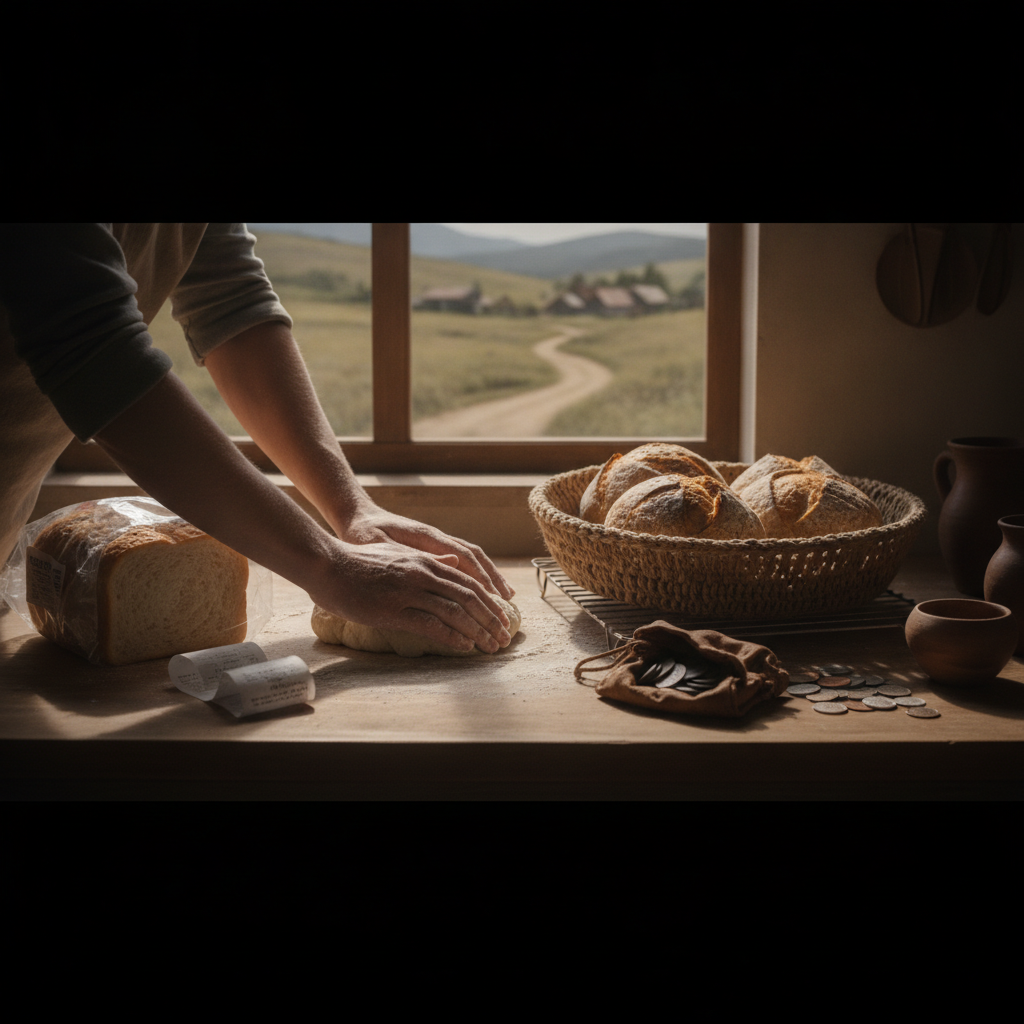
Small habits have a way of encoding large assumptions. Every time someone pulls into a drive-through for a morning coffee, swipes for a pre-made salad, or drops a packaged loaf into their cart without a second thought, they are doing more than making a purchase — they are quietly affirming a particular relationship between convenience, time, and what each is worth. These micro-transactions feel insignificant in isolation. Over months and years, though, they build an invisible framework for how a person understands value itself. The interesting shift happens not when someone stops buying convenience items altogether, but when they replace just one of them — regularly, intentionally — with something made by their own hands.
The Habit That Changes the Calculus
There is a concept in behavioral economics known as *effort justification* — the tendency to assign greater value to outcomes that required meaningful effort to produce. This principle, long studied in social contexts, translates quietly into domestic life in ways that most people never consciously register. When someone bakes their own bread on a Sunday afternoon instead of grabbing a plastic-wrapped loaf from a chain like Trader Joe's or Whole Foods, they begin to experience the product differently. The time spent becomes part of the object's worth. The loaf is no longer just bread — it's the hour of mixing and resting and the particular warmth of a home kitchen on a weekend morning. That experience, repeated weekly, begins to recalibrate how a person estimates the value of things they make versus things they simply buy.
This recalibration isn't nostalgic or ideological. It's perceptual. The more often a person engages in producing something from raw materials, the more clearly they can see what convenience actually costs — not just financially, but in terms of the experience traded away. A jar of pasta sauce made from summer tomatoes becomes a reference point. Every future jar of store-bought Rao's or Prego on a grocery shelf gets quietly measured against it. The comparison isn't about price per ounce — it's about a developing literacy in what things require, and therefore what they mean.
How Time Stops Feeling Like a Fixed Currency
One of the subtler transformations that emerges from regular handmade practice is a renegotiation of how time is understood. Modern consumer culture tends to treat time as a static commodity — something to be saved or spent, with convenience purchases functioning as a kind of exchange. You pay money to reclaim time. This model is pervasive, and it makes a certain kind of sense. But it rests on the assumption that all time feels equivalent, which lived experience contradicts almost entirely.
Time spent rushing through a task to preserve capacity for more rushing has a different texture than time spent making something with full attention. Researchers who study flow states — particularly those connected to craft traditions in Japanese culture, where the concept of *shokunin kishitsu*, or artisan spirit, holds deep social meaning — describe this distinction in terms of psychological density. An hour of attentive making can feel more restorative than two hours of passive consumption, even if the latter looks, on paper, like leisure. Once a person begins to feel this difference in their own kitchen or at their own workbench, the assumption that time saved through convenience is automatically time well-recovered starts to erode.
The Slow Shift in Spending Behavior
What tends to follow this perceptual shift is a gradual, unsentimental change in spending behavior. It rarely looks like austerity or self-deprivation. Instead, it resembles a quiet reordering of priorities — an emerging preference for fewer, more considered purchases over a steady stream of convenient ones. A person who has spent six months baking their own sourdough starts to notice that they're less drawn to impulse food purchases generally. Not because they've adopted a philosophy, but because they've developed a baseline. They know what went into something. They know what something can be.
This pattern appears across different categories. Someone who begins making their own cold brew coffee at home — a simple process requiring nothing more than coarse grounds, a mason jar, and overnight time — often finds, within a few weeks, that the reflexive stop at a café feels different. Not wrong, exactly, but more visible. The choice becomes conscious in a way it wasn't before. And conscious spending, by definition, tends to be more deliberate spending. Brands like Aeropress and Chemex have built entire customer bases partly on this dynamic — the ritual of manual preparation rewiring what a purchaser expects from their morning rather than simply what they pay for it.
What You Begin to Notice
Once you've replaced one weekly convenience purchase with a handmade version for a sustained period — six weeks is usually enough to begin feeling the shift — the changes that surface are less about the object and more about the lens. You start to notice effort in other places. The way a garment is constructed. The difference in texture between produce bought at a farmers' market in a neighborhood like Portland's Mississippi Avenue and the equivalent item under fluorescent warehouse lighting. You become, gradually, a more attuned reader of the material world around you. That attunement doesn't make you a more difficult consumer — it makes you a more honest one. The things you continue to buy for convenience, you buy with clear eyes. The things you choose to make, you make with a growing sense of what that choice actually yields. Neither purchase is wrong. But both feel, at last, like genuine decisions rather than automatic responses. That distinction — the move from reflex to intention — is the quiet reward of the practice, and it compounds in ways that no spreadsheet can quite capture.