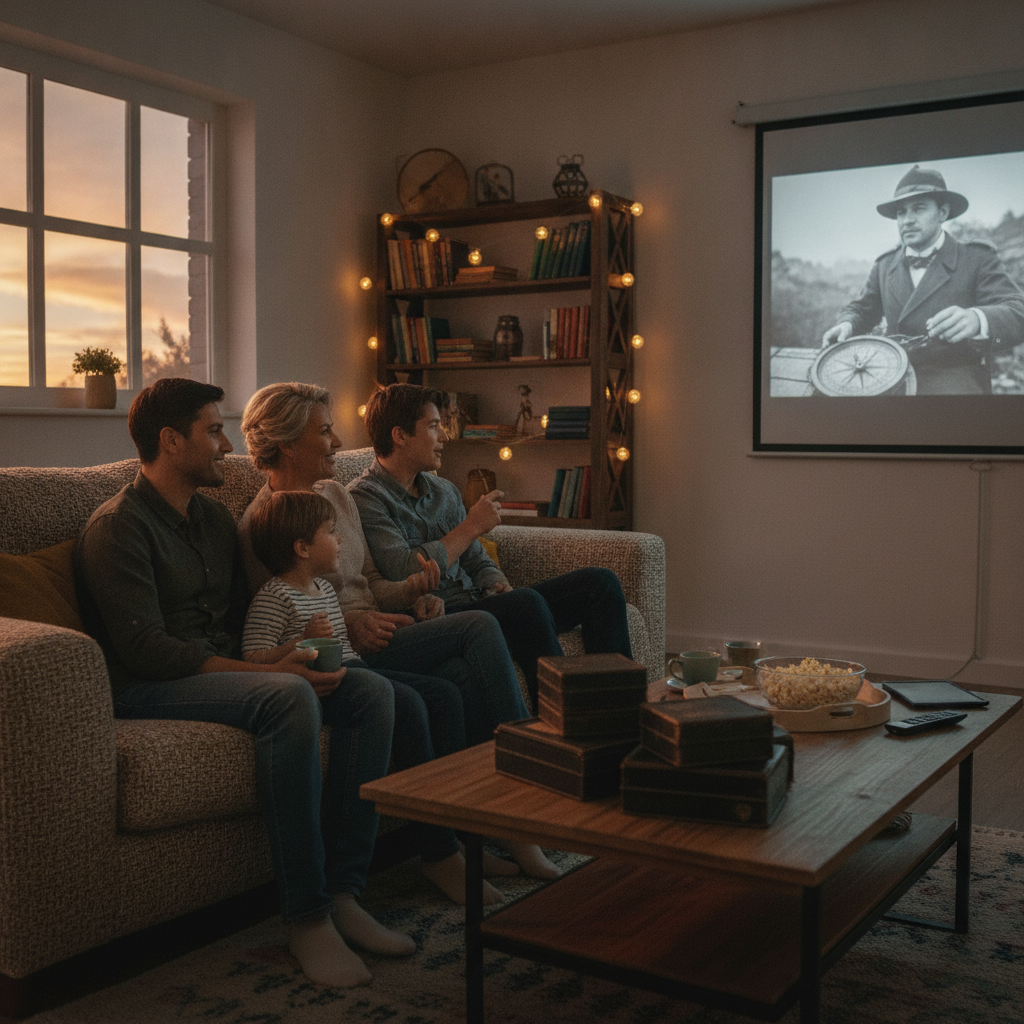
Attention, left unguided, tends to settle at the lowest point available — and in most households, that lowest point is the algorithmically arranged scroll of a streaming platform's home screen. What fills that space rarely arrives by choice; it arrives by default, which is an entirely different thing. The practice of intentionally curating a small, rotating collection of long-form documentaries as a shared household ritual runs counter to that drift. It asks something modest but meaningful: that the people living under one roof decide together what they want to think about, and then actually think about it.
The Difference Between Watching and Viewing
There is a distinction worth preserving between watching something and viewing it — between content absorbed without resistance and material engaged with a degree of intention. Long-form documentaries, particularly those running ninety minutes or longer, operate closer to the second category. They require the viewer to hold a thread across a sustained arc, to sit with ambiguity, and to arrive at the end without the artificial resolution that narrative fiction provides. Films like those produced by Errol Morris or the teams behind the Viceland documentary strand ask audiences to reconcile complexity rather than simply receive it. That demand is not a burden; it is precisely what makes communal viewing generative. When two people finish a film that raises more questions than it answers, there is material for genuine exchange rather than a brief recap and return to silence.
The ritual framing matters as much as the content itself. A household that watches a documentary on a Tuesday because nothing else appealed is engaging in passive consumption with a slightly higher production budget. A household that sets aside a Sunday evening, prepares a simple meal, and agrees in advance that this week's selection is the new Frontline episode on global water access has created a context — what anthropologists call a *liminal space*, a threshold moment set apart from ordinary routine — in which the same material lands differently. Context shapes reception, and reception shapes how much of a conversation the experience can carry afterward.
Curation as a Form of Household Intentionality
The word curation has been used so broadly that it risks losing its practical meaning, but its original sense — the careful selection and arrangement of a collection for a specific purpose — applies cleanly here. A rotating documentary collection of four to six titles, refreshed monthly or seasonally, gives a household a shared intellectual horizon without demanding the kind of commitment that a structured book club requires. Platforms like Mubi and the Criterion Channel, along with independent documentary distributors such as Dogwoof, offer curated libraries that reward browsing with genuine breadth rather than algorithmic similarity loops. The act of choosing together — scrolling through a short list, negotiating between subjects, landing on something neither person would have selected alone — is itself a form of collaborative attention that most households rarely exercise.
A rotating structure prevents calcification. If the same household defaults to the same genre every cycle, the ritual becomes a mirror rather than a window. Introducing deliberate range — one month a portrait of a disappearing craft tradition in rural Japan, the next an investigation of urban housing policy in a mid-sized American city like Pittsburgh or Richmond — keeps the shared conversation from narrowing into comfort. The mild discomfort of watching something unfamiliar is part of the ritual's value. It generates the conversational friction that produces actual thought rather than agreement by default.
What Long-Form Duration Actually Provides
Shorter content — the ten-minute explainer, the three-episode docuseries with cliffhanger pacing — tends to produce a particular kind of engagement: rapid, satisfying, and quickly replaced. Long-form documentaries work differently because their duration requires the audience to develop a relationship with the material. A filmmaker spending ninety minutes with a single community, a specific ecosystem, or a contained historical event creates conditions for genuine accumulation. The viewer's understanding of the subject shifts across the runtime, and that internal shift becomes available for conversation in a way that a shorter piece rarely enables. When two people have experienced the same arc of growing comprehension, they have something substantive to compare — not just reactions, but processes.
This is why the conversation that follows a long documentary often extends well past the film itself, into adjacent territory the film never directly addressed. A documentary about the North Sea fishing industry might generate a two-hour conversation about food policy, labor economics, and a half-remembered trip one partner took to Bergen years ago. The film is a starting point, not a destination. That generative quality is precisely what distinguishes it from the kind of content designed to be consumed, forgotten, and replaced by the next recommendation.
Displacing Passive Consumption Without Declaring War on It
No household ritual survives if it positions itself as a corrective or a moral upgrade. The documentary rotation works not because it replaces passive consumption by force but because it occupies the time and attention that passive consumption would otherwise fill — and it does so with something that leaves a residue. After a long week, the appeal of scrolling without commitment is real and worth acknowledging. The ritual does not ask for that energy to be abandoned; it asks only that one evening per week, or even per fortnight, is held with a slightly different orientation. That is a genuinely small request, and its returns are disproportionate.
Over time, households that maintain this kind of practice tend to notice a shift in how they talk to each other — not only during the designated viewing evenings but in the conversational texture of ordinary days. Shared references accumulate. A phrase from a film surfaces during a disagreement and reframes it. A subject introduced through a documentary becomes the entry point for a book one partner picks up independently. The ritual, quietly and without announcement, expands the household's common language.
If attention is a household's most renewable and most squandered resource, then the small act of deciding together what to give it to — and then sitting with the result long enough for it to matter — is among the more sensible investments available. Not every evening needs to carry weight. But reserving a few for something that resists easy consumption, and then talking about it afterward in an ordinary kitchen over ordinary dishes, is a way of choosing depth over volume. That choice, made consistently, has a way of compounding.