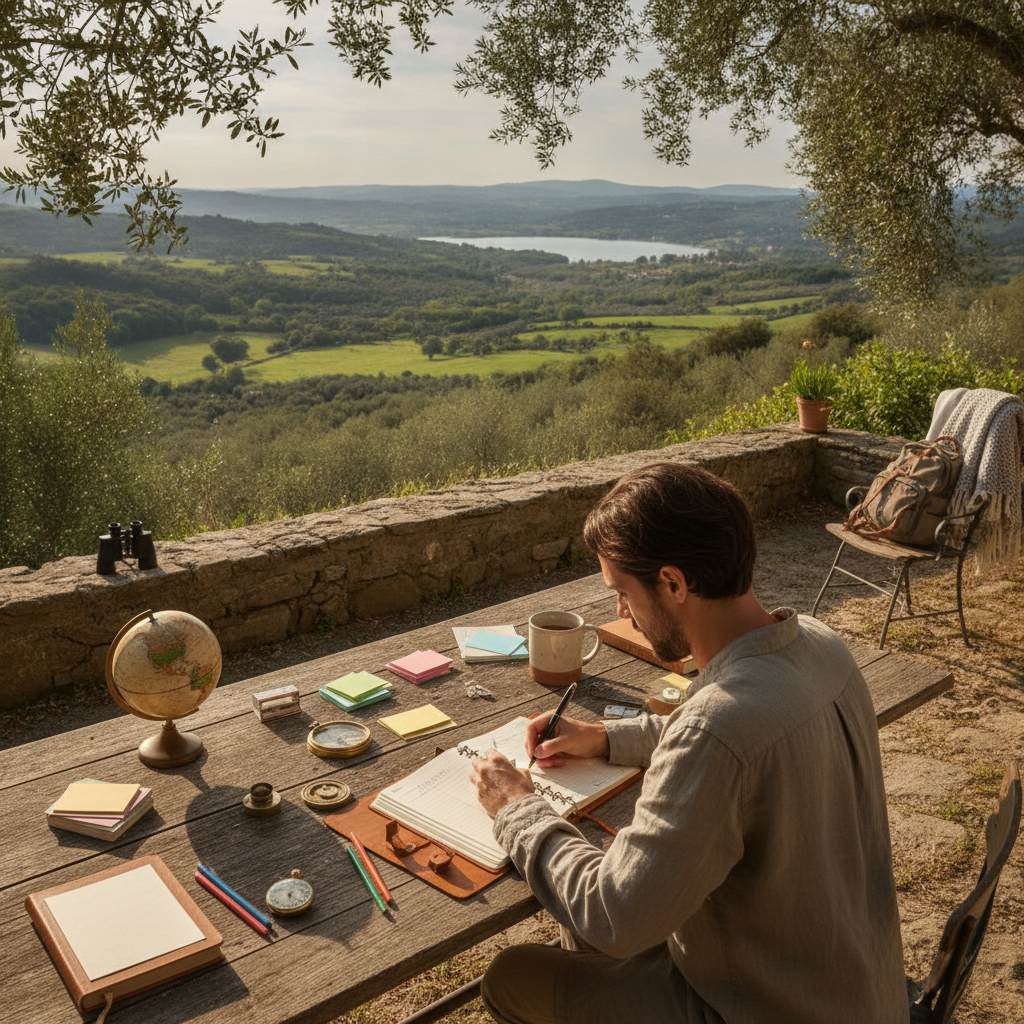
There is a particular kind of mental exhaustion that arrives not from doing too much, but from deciding too much. By midweek, most people carry the accumulated weight of dozens of small choices — what to respond to first, which task to reschedule, whether a nagging obligation belongs on today's list or can be safely deferred. The calendar fills with notifications, the inbox reasserts itself every few hours, and somewhere in that digital churn, the clearer priorities of Monday morning begin to blur. What starts as intention gradually becomes reaction, and the week slips by in a state of perpetual catch-up rather than deliberate progress.
The Case for Unplugging to Think More Clearly
The concept of *mono no aware* — a Japanese phrase describing the bittersweet awareness of impermanence — doesn't immediately seem connected to weekly planning, but it carries a useful undercurrent: when something is fleeting, it demands presence. A week is exactly that kind of finite container. It has edges. It begins and ends. And yet most people treat it as a formless extension of the week before, carrying over stress, unfinished threads, and vague intentions without ever pausing to reset. Designing a deliberate analog planning session — away from screens, grounded in pen and paper — forces a brief reckoning with that finitude. A physical notebook from a brand like Leuchtturm1917 or Moleskine doesn't autocomplete your thoughts or interrupt them with a push notification. It simply receives what you bring to it, which turns out to be exactly the kind of low-stakes environment where honest prioritization can happen.
The neuroscience behind handwriting and cognition has been discussed widely enough that it's become something of a cultural touchstone among productivity writers. What's less often emphasized is the secondary benefit: the act of writing by hand is slow enough to filter. When someone types a to-do list, the speed of entry roughly matches the speed of anxious thought, which means everything gets equal billing. When they write by hand, the slight friction of the medium forces a subtle triage. The items that survive the pen tend to be the ones that actually matter. That friction is a feature, not an inefficiency.
Structuring the Session Without Overthinking It
A weekly analog planning session doesn't need to be elaborate to be effective. In its simplest form, it's a quiet thirty to forty-five minutes — Sunday evening or early Monday morning tend to work well for most schedules — in which someone sits with a notebook, perhaps a cup of coffee, and no open tabs. The goal isn't journaling in the emotional sense, and it isn't productivity theater. It's closer to what the French call *mise en place*, the kitchen practice of gathering and arranging everything before cooking begins. Before the week starts, this session asks: what actually needs to happen, in what order, and what can be released without consequence?
The structure that tends to serve people best involves three loose passes. The first is a simple brain dump — everything outstanding, pending, or nagging gets written down without judgment. The second is a gentle sorting: what belongs to this week, what belongs to a later date, and what doesn't belong anywhere because it's been on the list long enough to suggest it was never really a priority. The third pass is the actual weekly map — not a minute-by-minute schedule, but a rough sense of which days carry which kinds of work. Tools like a simple weekly spread in a dot-grid notebook, or even a folded sheet of paper divided into columns, work as well as any specialized planner system from a brand like Panda Planner or Passion Planner. The format matters far less than the ritual of doing it consistently.
How Analog Planning Reduces Midweek Decision Fatigue
Decision fatigue is a well-documented phenomenon, and its effects compound across the week in ways that are easy to underestimate. When priorities haven't been established in advance, every moment of ambiguity becomes a micro-decision: is this email urgent or can it wait, should I work on the big project now or after the meeting, is this errand something I should fold into today or batch for Thursday? Each of those small decisions draws from the same cognitive reserve, and by Wednesday afternoon, that reserve is noticeably depleted. People become more reactive, more prone to distraction, and more likely to default to the path of least resistance — which is rarely the path of most importance.
A good analog planning session front-loads those decisions in a single, calm block rather than distributing them across five reactive days. When someone sits down Wednesday morning and already knows that the afternoon is reserved for deep work, the decision has already been made. The cognitive load of that choice has been paid in advance, during a moment when the mind was rested and uncluttered. This is the quiet leverage of the weekly planning habit: it doesn't add discipline to the week so much as it trades scattered daily willpower for one concentrated act of intentionality.
Reclaiming the Week Before It Begins
You don't need a special system, a productivity guru's framework, or a beautifully designed planner to begin. What the weekly analog session asks of you is simpler and more honest than any app: that you sit still for a short while, hold a pen, and look at the coming week as something with shape. Choose a consistent time and protect it lightly — not rigidly, but enough to make it a reliable anchor. Turn the phone face-down. Close the laptop. Let the quiet do some of the work. Over several weeks, something shifts: Wednesday arrives and the week feels less like a current pulling you along and more like a path you chose. The decisions that used to accumulate as midweek fog have already been sorted. The priorities are visible because you made them visible, with your own hand, before the noise had a chance to decide for you.
That image from the start of the week — the blur of notifications, the inbox, the low hum of unresolved tasks — doesn't disappear entirely, but it loses its authority. And that, quietly, is the whole point.