There is something quietly absurd about a block of twenty households, each owning its own electric drill used perhaps twice a year, sitting in garages and closets while the same neighbors pass each other on driveways with little more than a wave. The accumulation of seldom-used tools is one of the most normalized inefficiencies in modern domestic life — each purchase justified in the moment, each item fading into storage shortly after. What gets lost in this pattern isn't just money. It's the texture of neighborhood life, the small negotiations and exchanges that once made proximity feel like something more than shared geography.
The Economics of Low-Frequency Ownership
Most households own tools that see use only a handful of times across their entire lifespan. A tile saw for a bathroom renovation. A pressure washer for a single spring cleaning. A stud finder that migrates from drawer to drawer without purpose. The financial logic of purchasing these items rarely holds up under scrutiny: the cost of ownership, accounting for storage space, depreciation, and the occasional replacement of items that have corroded or seized from disuse, often exceeds what periodic borrowing or rental would have cost. Tool libraries — whether informal arrangements between neighbors or more structured community programs like those run through neighborhood platforms such as Peerby or NeighborGoods — operate on a simple premise: not everyone needs to own everything, as long as someone nearby does.
This model, known in economics as collaborative consumption, has roots far older than any app. The concept appears across cultures in forms like the Japanese practice of *moai* — informal social support groups where members pool resources and goodwill — or the Scandinavian tradition of *dugnad*, a communal work effort where neighbors gather to accomplish tasks that benefit the group. These aren't nostalgic curiosities. They reflect a durable logic: shared ownership of infrequently used items reduces per-household cost while preserving access. A rotating tool library among neighbors does the same thing in miniature, without requiring institutional infrastructure or formal membership fees.
What a Shared System Actually Looks Like
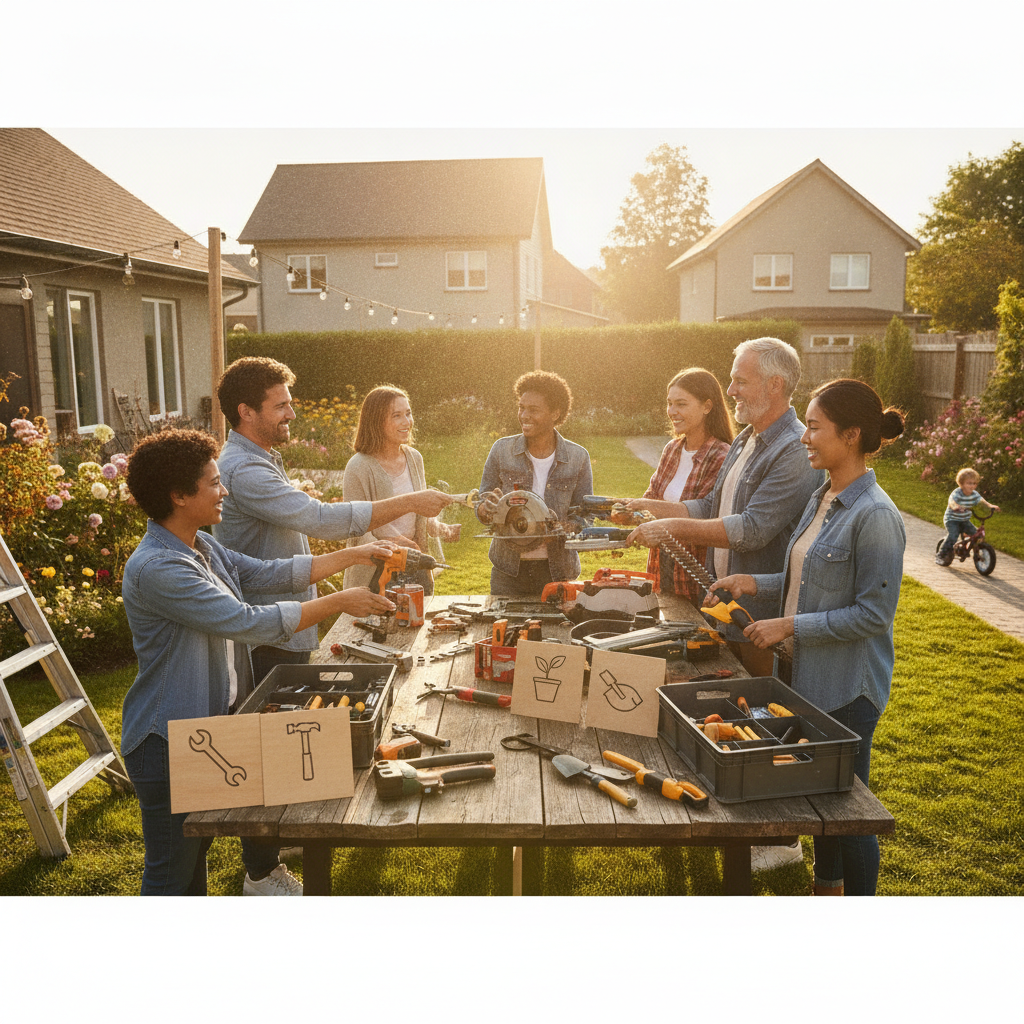
The most effective informal tool-sharing arrangements tend to start small and grow organically. A single exchange — one neighbor lending a circular saw to another for a weekend deck repair — often plants the seed. What follows, over months and sometimes years, is a gradual mapping of who owns what and who is willing to share it. In neighborhoods with stronger social fabric, like the close-knit residential streets found in older urban districts of Portland, Oregon or Savannah, Georgia, these arrangements can eventually encompass dozens of items: ladders, paint sprayers, soil tillers, pipe wrenches, and more. The key isn't comprehensiveness. It's the establishment of trust and a loose but reliable protocol — a simple group text thread, a shared note in an app like Nextdoor, or even a physical sign-up sheet posted in a common area.
What makes these systems work over time is reciprocity without strict accounting. Neighbors who participate don't typically track the precise exchange of favors; instead, they operate under what sociologists call a generalized reciprocity norm — the understanding that contributing to the collective pool is its own form of long-term benefit. This stands in contrast to the more transactional frameworks of formal rental services, where every use is monetized and the relationship stays commercial. The informal library carries social weight that a hardware store rental counter simply cannot replicate.
The Quiet Deepening of Neighborhood Bonds
The effects of a functioning tool-sharing arrangement on community cohesion are subtle but real. What begins as a practical convenience gradually reshapes how neighbors relate to one another. The person who lends a power sander becomes, in the borrower's mind, someone with a name, a household, a small history. The return of the item — often accompanied by a brief conversation, a piece of unsolicited but useful advice about the project at hand — creates the kind of low-stakes, repeated contact that social researchers consistently identify as the foundation of genuine neighborliness. It isn't dramatic. It doesn't require organized events or neighborhood association meetings. It happens in driveways and at front doors, in exchanges that take three minutes and linger longer.
This is where the spending benefit and the social benefit become difficult to separate. Households that feel embedded in a trusting local network tend to consume differently. The impulse to purchase a tool for a single project weakens when there's a reasonable expectation that someone nearby already has it. Over the course of a year, those avoided purchases add up across multiple categories — not just tools, but folding tables borrowed for a party, a carpet cleaner used once for a move, specialty kitchen equipment needed for a single recipe. The savings aren't dramatic in any single instance, but they accumulate into a meaningful shift in household spending patterns.
Building the Habit Into Daily Life
For those who want to formalize what might otherwise stay informal, the approach doesn't need to be complicated. Starting with a simple inventory — a shared document listing what each participating household owns and is willing to lend — creates the visibility that makes borrowing feel like a legitimate first option rather than an imposition. Apps like Nextdoor make it easy to post availability or requests within a defined geographic radius, and many neighborhoods already have active groups where these exchanges happen naturally. The cultural shift required isn't large. It's mostly a matter of asking before buying, and being willing to say yes when asked.
If you're considering starting a similar arrangement in your own neighborhood, the most effective entry point is usually a single, genuine offer. Post what you're willing to share. Frame it without expectation of immediate return. The reciprocity tends to follow on its own, and the library grows from there — not because it was designed to, but because the underlying logic of shared ownership is one that most people recognize as sensible once they're reminded it's an option.
The drill sitting unused in the garage, the ladder leaning against the wall through three seasons — these are small symbols of a kind of self-sufficiency that, taken to its extreme, quietly isolates. The block of twenty households with twenty drills reflects not abundance but a failure of imagination about what neighbors are actually for. A tool library doesn't solve that entirely, but it opens a door. And in the opening, something older and more useful than a power drill tends to walk through.